AI Dock Management: Shaping the Modern Marine Ecosystem
For decades, managing a marina was an art form relying on paper ledgers, whiteboards, and local knowledge. Dock masters and harbour managers kept complex spatial layouts of their basins in their heads, balancing vessel lengths, drafts, beam widths, and power requirements by hand. However, as the global yachting population grows and boaters demand instant, on-demand services, these legacy manual systems are reaching their breaking points.
The modern waterfront requires a transition from isolated, static docks to a fully integrated, intelligent marine ecosystem. This transformation is driven by AI dock management—a revolutionary approach to spatial and operational coordination that maximises efficiency, boosts revenue, and connects boaters with available berths in real time. Whether you are a commercial harbour manager looking to streamline operations, a yacht club coordinating peak-season event arrivals, or an investor with a premium berth for sale, understanding the power of artificial intelligence on the water is essential to staying competitive.
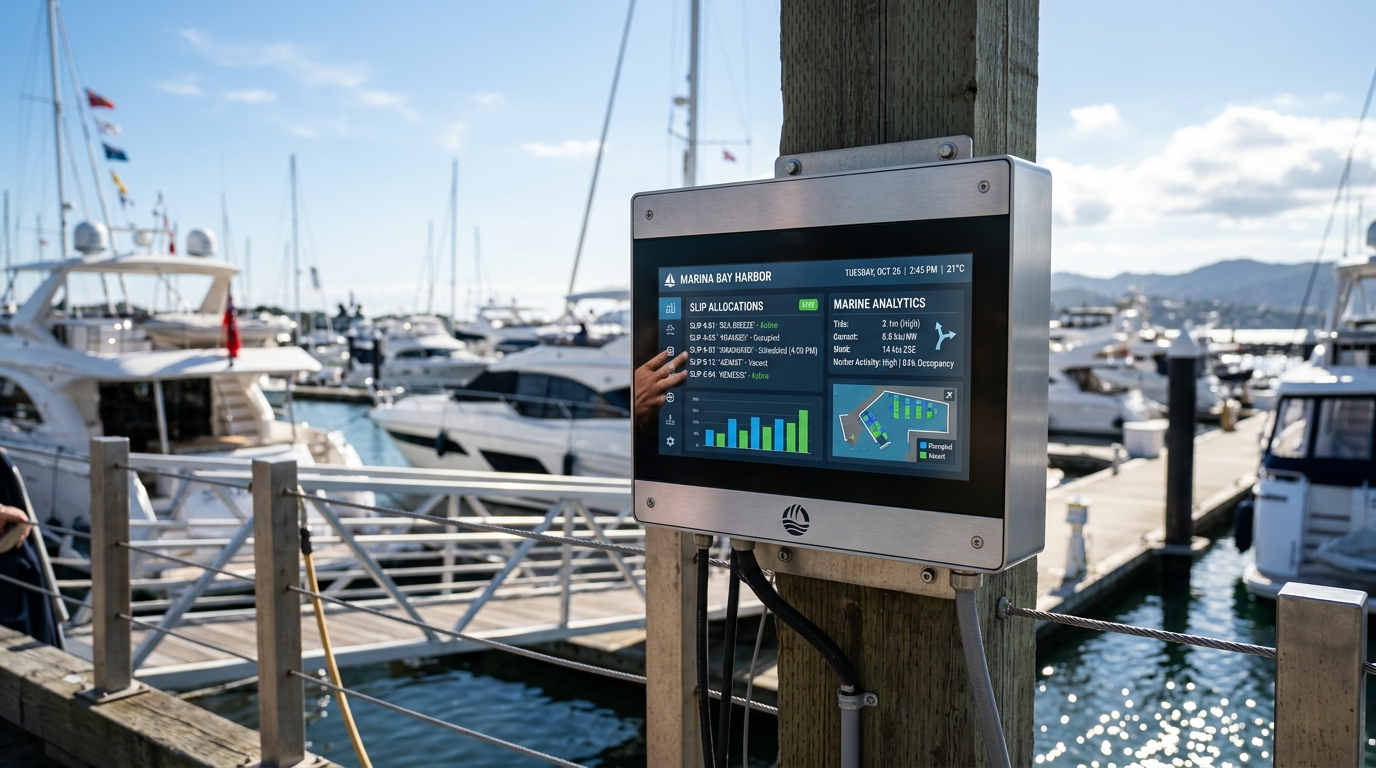
Shifting from Manual Tetris to AI Dock Management
Every marina operator understands the daily challenge of slip allocation. On a busy Friday afternoon, vessels of varying shapes and sizes arrive in rapid succession. One yacht requires 50-amp shore power and a deep-water slip; another needs a wide beam allocation but minimal draft clearance; a third has an outboard engine configuration that allows for overhang flexibility. Historically, resolving this puzzle meant hours of manual reshuffling, often resulting in empty berths due to safe-margin conservatism.
Implementing AI dock management changes this dynamic entirely. Instead of relying on static spreadsheets, smart marina software uses predictive algorithms to analyse incoming vessel data and match it instantly with the ideal slip. The AI assesses dozens of parameters simultaneously, including water depth, tide schedules, wind directions, shore power configurations, and vessel geometry.
By dynamically recalculating slip assignments, the platform ensures that spatial utilization is always optimised. This minimizes the physical shuffling of boats and reduces the risk of human error, protecting both vessel hulls and marina infrastructure. For the operator, this translates directly to higher marina occupancy, streamlined operations, and a significantly reduced administrative workload for the dock crew.
Connecting the Marine Ecosystem for Greater Yields
A truly connected marina does not operate in a vacuum. It forms a key node within a broader, international network of boaters, service providers, and private property owners. Modern digital platforms are bridging the gap between traditional commercial marinas and underutilised private assets, such as a private dock rental or private jetties.
Through a shared global network, boaters can easily locate and reserve berths that match their exact specifications. This system allows private waterfront property owners to list their unused jetties, effectively expanding the available berthing inventory during peak seasons. By integrating these private listings into the wider ecosystem, boaters gain access to more mooring options, while private owners tap into a consistent passive income stream.
This unified network also creates a highly liquid marketplace for long-term investments. When a slip or a commercial berth for sale becomes available, historical occupancy data, operational analytics, and verified yield records are easily accessible. This level of transparency builds trust among buyers, sellers, and marine investors, elevating the financial sophistication of waterfront real estate.
Optimising Revenue with Advanced Marina Analytics
Understanding the financial performance of a marina requires deep insight into seasonal trends, pricing elasticities, and operational costs. Relying on basic occupancy rates is no longer sufficient for modern businesses looking to scale. This is where comprehensive marina analytics play a vital role.
By monitoring booking behaviors, length-of-stay patterns, and utility usage, intelligent software generates detailed visual reports via a centralised revenue dashboard. Operators can identify precisely when their facilities are underutilised and implement dynamic pricing strategies to attract transient boaters during slower periods. Conversely, during peak demand, the system can automatically manage premium pricing and direct excess demand to automated waitlists, ensuring that no revenue opportunity is missed.
To illustrate the difference between traditional management and an AI-driven, analytical approach, consider the following operational comparison:
- Manual Slip Allocation: Highly vulnerable to human error, relies on conservative margins, results in frequent double-bookings or artificial vacancies.
- AI Dock Management: Automated, multi-parameter spatial matching that updates in real time, maximizing dock space utilization.
- Traditional Booking: Time-consuming phone calls, manual email confirmations, and physical card payments.
- Online Marina Booking: Instant, self-service reservations with automated confirmation and integrated Stripe secure payments.
- Legacy Analytics: Retroactive, paper-based billing reviews offering little to no predictive insight.
- Predictive Analytics: Forward-looking revenue forecasting, dynamic pricing suggestions, and automated waitlist triggers.

The Practical Path to Marina Automation
Adopting automated technology does not require a complete overhaul of your physical docks overnight. Rather, it is about layers of smart integration that gradually transition your operations into a digital-first workflow. The first step for most operators is implementing an intuitive marina booking software that handles the administrative heavy lifting.
When a boater initiates an online marina booking, the system should capture all necessary vessel documentation, insurance certificates, and payment details upfront. This ensures that when the vessel arrives at the fairway, the dock master is already fully informed, and the boater can secure their vessel without delay. Over time, as more data flows through the system, the AI engine begins to suggest optimal slip arrangements and predict maintenance cycles for dockside utility pedestals.
This level of automation also enhances safety. In the event of an approaching storm, an automated platform can instantly communicate safety protocols to all docked vessels, monitor slip occupancy, and help operators coordinate emergency vessel relocations. By removing manual friction from daily administrative tasks, your staff can focus on what they do best: delivering exceptional, face-to-face customer service on the docks.
Unlocking Value for Private Dock Owners
The benefits of this digital transformation are not exclusive to multi-million-dollar commercial marinas. Individual waterfront property owners holding a private dock rental stand to gain immensely from this technological shift. Historically, renting out a private jetty involved local classified advertisements, back-and-forth phone negotiations, and informal payment agreements that carried significant financial and legal risks.
By listing a private slip on a professional, connected marketplace, owners gain access to the same high-level tools used by elite yacht clubs. This includes robust vessel verification, automated booking agreements, clear liability structures, and secure electronic payment processing. Boaters can view these private berths on an interactive map, filter by depth and amenities, and complete their berth reservation with complete confidence, knowing that the listing is verified and secure.

Securing the Future of Global Boating Networks
As maritime transport and recreational boating continue to expand, the demand for integrated infrastructure will only intensify. The future of the marine industry belongs to those who view their docks not just as physical wood and concrete, but as vital data points within a global marina network.
By connecting individual harbours, private berths, and yacht clubs through a unified digital platform, we are building a seamless travel experience for boaters worldwide. Imagine a cruising yacht journeying along a coastline, where its path is smoothed by automated slip allocations, real-time depth warnings, and pre-booked overnight stays—all managed through an integrated, intelligent dashboard. This is the promise of a fully digitised waterfront, and it is a reality that is being built today.
Frequently Asked Questions
What is AI dock management and how does it work?
AI dock management is the use of intelligent algorithms to automate and optimize the allocation of slips and berths within a marina. It analyses vessel characteristics (such as length, draft, beam, and power needs) alongside environmental variables (such as tides and wind) to place vessels in the safest, most space-efficient locations in real time.
How does online marina booking benefit a traditional marina operator?
An online booking system allows boaters to view live berth availability, upload insurance documents, and make payments 24/7. This reduces administrative overhead, eliminates double-bookings, captures customer data instantly, and secures revenue up-front through secure payment gateways.
Can private jetty owners use smart marina software?
Yes. Private dock and jetty owners can list their properties for rent or sale on a digital marina marketplace. This allows them to manage bookings, verify boater credentials, handle payments securely, and access a global network of boaters searching for alternative mooring options.
How does marina analytics help increase overall revenue?
Marina analytics track key performance indicators such as occupancy rates, average length of stay, utility usage, and peak booking times. This data enables operators to implement dynamic pricing, manage automated waitlists, and make informed capital investment decisions based on historical trends.
Is boater information and payment data secure on these platforms?
Modern platforms like Marina Match use enterprise-grade encryption and secure payment processors like Stripe to ensure all financial transactions, personal boater information, and vessel documentation are fully protected and compliant with international security standards.
Embrace the Digital Waterfront with Marina Match
The maritime industry is undergoing a profound digital evolution. From the automation of commercial slip allocation to the streamlined listing of private berths, technology is unlocking unprecedented efficiency, safety, and profitability across the global waterfront.
At Marina Match, we are proud to be building the essential infrastructure for this connected future. Our comprehensive platform combines a highly intuitive dock master dashboard, live map views, advanced marina analytics, and a robust global marketplace to bring clarity and ease to marina management. Whether you are seeking to optimise your commercial operations, secure a premium berth for sale, or easily coordinate your next voyage, Marina Match offers the intelligent tools you need to succeed.
Ready to experience the future of smart waterfront management? Discover how Marina Match can transform your marine assets and streamline your operations by exploring our platform today.
Do you run a marina or own a berth?
Reach boat owners searching for berths. Listing is free.