

Driving Growth: How AI Marina Management Transforms the Marina Business
Waterfront management has reached a pivotal transition point. For decades, harbour masters, dock masters, and yacht club directors relied on manual logbooks, static spreadsheets, and physical whiteboards to oversee dockage. While these traditional operational methods sufficed when vessel volume was lower and boater expectations were simpler, today's marine ecosystem demands precision, real-time response, and interconnected digital services. As vessel sizes increase and coastal real estate grows more premium, maximizing dock utilization while delivering an effortless boater experience has become the ultimate priority for every commercial marina business.
Integrating AI marina management into daily marine operations represents a paradigm shift. Rather than reacting to arrivals at the fuel dock or managing chaotic slip requests via radio, intelligent automation equips marina teams with predictive tools. By unifying live telemetry, real-time draft and beam requirements, dynamic pricing, and online berth reservations into a single connected platform, modern marinas can eliminate administrative bottlenecks, maximize occupancy, and unlock untapped waterfront yield.
The Strategic Role of AI Marina Management in Modern Harbors
At its core, modern dock operations require balancing fluctuating vessel dimensions, transient booking windows, maintenance schedules, and seasonal weather changes. Managing these variables manually often leads to unutilized water space—commonly known as dead space—where a slip lies empty because scheduling gaps prevent fitting arriving vessels safely.
Through AI marina management, dock allocation transitions from a static grid to an active, spatial puzzle solver. An AI-ready platform analyzes vessel parameters—including length overall (LOA), beam, draft, electrical power draw, and fender positioning—and matches them instantaneously against live dock dimensions. This automated precision ensures that larger vessels are positioned alongside deep-water piers while smaller craft occupy compact finger slips, maximizing linear dock usage without compromising safety.
- Dynamic Spatial Optimisation: Automatically calculates optimal slip layout based on vessel geometry and water depth constraints.
- Automated AI Booking: Handles instant reservations 24/7 without requiring manual approval from busy harbour office staff.
- Predictive Inventory Control: Anticipates upcoming check-outs, maintenance windows, and seasonal transitions to minimize idle berth time.
- Unified Channel Management: Synchronizes availability across direct booking engines and third-party marine marketplaces in real time.
Bridging Physical Docks and Digital Workflows
A major challenge for marina operators is maintaining accurate operational visibility across sprawling docks, swing moorings, and dry stack facilities. Operational friction frequently arises when field personnel on the pontoon are disconnected from the front-office management system.
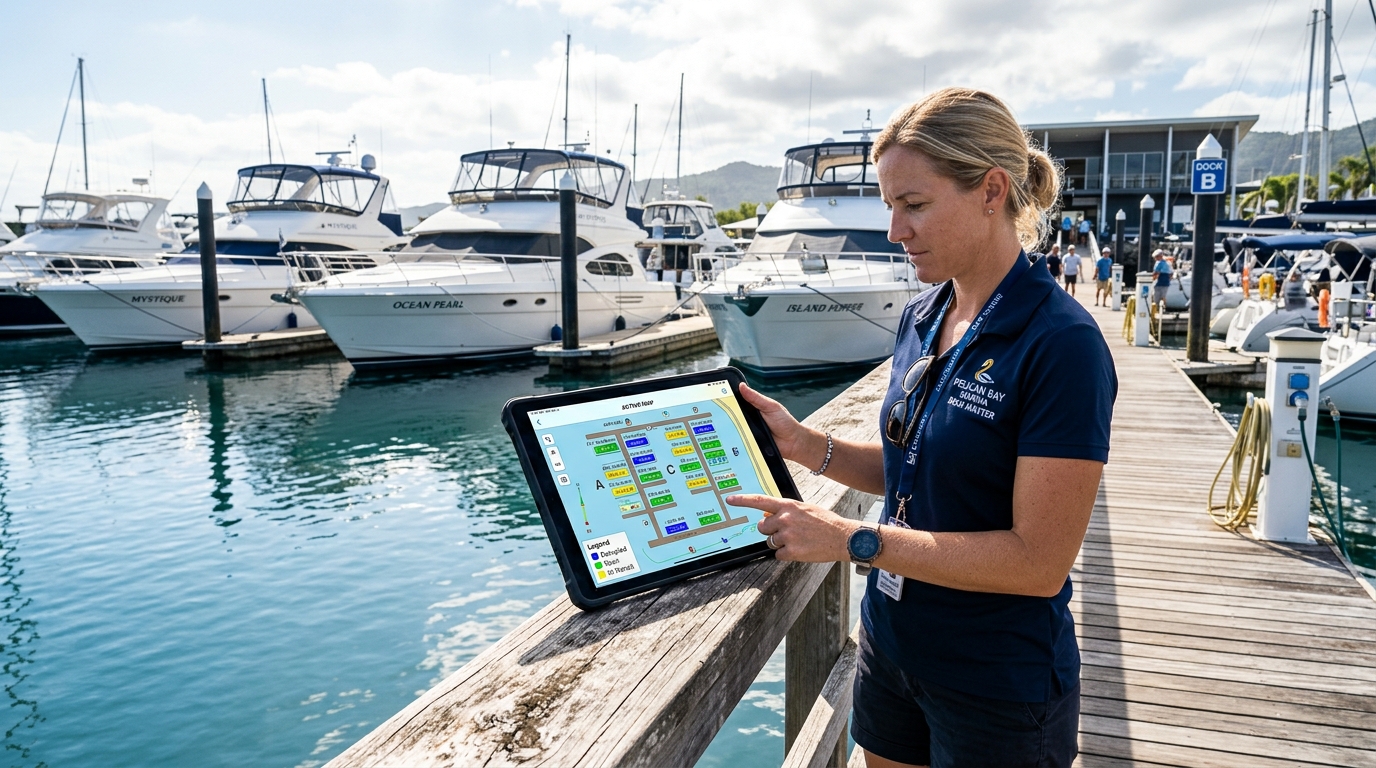
Modern marina management software resolves this disconnect by giving dock personnel access to a comprehensive Dock Master Dashboard on mobile devices. When a vessel approaches, dock tenders can view vessel details, captain preferences, and power requirements directly from their handheld screens. Simultaneously, boaters benefit from an intuitive Boater Dashboard where they can submit digital documents, request utility hookups, pay invoices, and view interactive Marina Map View layouts before tying up.
When routine tasks—such as verifying insurance certificates or confirming length measurements—are digitized, administrative work drops significantly. Front-office teams shift their focus from manual data entry to delivering personalized customer service, while line-handlers spend less time searching for vessel records and more time ensuring safe dockings.
Unlocking Unused Waterfront Capacity with Marketplace Integration
Coastal waters contain vast amounts of underutilized dock space. Beyond commercial marina slips, thousands of privately owned waterfront assets—such as a private jetty, deep-water pontoon, or residential waterfront dock—remain empty for long periods during the boating season. Historically, monetizing these isolated assets was difficult due to liability concerns, complex booking logistics, and lack of marketing reach.
By connecting private listings to a global Marina Marketplace, private property owners and small waterfront businesses can turn idle structures into active revenue generators. Whether listing short-term berths for rent or long-term berths for sale, digital marketplaces streamline customer discovery, handle payment processing, and enforce vessel verification automatically.
For established marinas, marketplace integration acts as a seamless extension of their primary inventory. During peak holiday weekends when permanent slips are full, an automated waitlist engine can suggest alternative options—such as nearby private moorings or partner jetties—keeping boaters within the connected marine network rather than turning them away.
Real-Time Data, Marina Analytics, and Revenue Maximization
Sustainable growth in the marina industry requires actionable business intelligence. Operating without centralized marina analytics leaves executives relying on historical guesses rather than real-time metrics. Incorporating structured financial data and operational telemetry allows operators to optimize rate cards, track utility consumption, and streamline billing processes.
A central Revenue Dashboard provides detailed insight into average revenue per linear foot, seasonal occupancy trends, and utility usage patterns. Coupled with dynamic pricing algorithms, smart marina software can adjust daily rates based on localized demand signals, weather forecasts, upcoming marine events, and real-time berth supply.
| Operational Focus | Traditional Marina Process | AI-Driven Smart Marina Approach |
|---|---|---|
| Berth Allocation | Manual whiteboard mapping & VHF radio requests | Instant algorithmic spatial mapping & AI berth allocation |
| Booking & Payments | Paper forms, phone calls, physical card processing | Self-service online booking & Stripe secure payments |
| Inventory Visibility | Static daily walks by dock staff | Live berth availability with interactive marina map views |
| Yield Optimization | Fixed seasonal rate cards | Dynamic rate adjustments based on real-time market demand |
Financial security is equally crucial. Modern management platforms integrate with enterprise gateways like Stripe Secure Payments to ensure transparent, PCI-compliant transactions. Boaters can settle dockage fees, electrical charges, and transient amenities directly through their mobile web browser or app, reducing outstanding receivables and simplifying month-end bank reconciliations for corporate accountants.

Building a Scalable Ecosystem: Local Jetties to Global Networks
The modern marine industry is shifting away from isolated harbours toward interconnected marine networks. Modern boaters travel extensively across regional coastlines and international waterways, expecting consistent digital conveniences wherever they drop anchor. Whether visiting a regional yacht club, cruising into a urban municipal facility, or renting a private pontoon berth, customers seek instant confirmation and unified billing.
Establishing a connected global marina network allows separate facility operators to share non-sensitive availability data while keeping individual accounting completely isolated. Boaters gain a single digital identity that holds their vessel registration, insurance documentation, and billing preferences, making check-ins across multiple destinations smooth and consistent.

For enterprise marina groups and marina investment funds, unified software infrastructure accelerates portfolio scaling. Acquisition targets can be integrated into the central management dashboard within days rather than months, standardizing standard operating procedures (SOPs), financial reporting, and transient booking protocols across every asset.
Frequently Asked Questions
How does AI marina management improve operational efficiency?
AI marina management automates routine administrative tasks such as slip allocation, reservation confirmations, and waitlist management. By matching vessel specifications with accurate dock geometry and live berth availability, it eliminates manual scheduling errors, reduces dock master workloads, and maximizes linear dock yield.
Can private jetty owners list their docks on a digital marina marketplace?
Yes. Private jetty and private dock owners can publish their berths for rent or berths for sale through a connected marina marketplace. This provides private owners with secure payment processing, identity verification, and direct access to a broad audience of qualified boaters searching for transient or long-term dockage.
What is the difference between legacy marina software and smart marina technology?
Legacy marina software primarily operates as a local desktop database or digital ledger for basic invoicing and manual slip assignment. In contrast, smart marina technology relies on cloud platforms, real-time IoT telemetry, automated waitlists, dynamic pricing engines, and mobile dashboard interfaces for both staff and boaters.
How does online marina booking software reduce administrative overhead?
Online marina booking software allows boaters to view live berth availability, submit vessel specifications, upload mandatory insurance documents, and pay securely online 24/7. This minimizes phone inquiries and email exchanges, enabling dock staff to concentrate on harbor maintenance and guest hospitality.
Is AI booking secure for processing financial transactions and boat data?
Modern platforms prioritize security by integrating with tier-one payment processors like Stripe Secure Payments. Financial transactions are encrypted end-to-end, while vessel documentation and personal information are stored in cloud infrastructure that complies with global data privacy regulations.
How does dynamic pricing work within a marina revenue dashboard?
Dynamic pricing algorithms analyze real-time market variables including local dock occupancy, seasonal demand surges, special marine events, and weather conditions. The system suggests or automatically applies optimized rate cards to maximize overall harbor yield without compromising competitive positioning.
Conclusion & Strategic Outlook
The transformation of the marine industry is accelerating rapidly. As boater expectations shift toward instant digital convenience and operators face rising waterfront land values, adopting AI marina management moves from a competitive advantage to an operational necessity. Facilities that embrace integrated automation, real-time analytics, and open network capabilities will continue to achieve higher occupancy, lower operational friction, and stronger customer loyalty.
Key takeaways for progressive marina managers, investors, and private dock owners include:
- Eliminate Operational Silos: Unify back-office management, dock operations, and boater interactions within a single cloud platform.
- Maximize Linear Capacity: Use dynamic spatial algorithms to eliminate empty space and maximize yield per foot.
- Capitalize on Network Effects: Connect dock inventory to global marine marketplaces to capture transient demand and grow revenue.
- Implement Data-Driven Pricing: Use real-time analytics and dynamic pricing tools to protect profit margins against inflation and rising waterfront costs.
As the premier platform bridging dock management, market distribution, and intelligent technology, Marina Match provides the complete infrastructure modern harbors need to excel. Discover how our modular software transforms waterfront management, expands marketplace reach, and delivers an exceptional boater experience across your entire marine asset portfolio today.
Do you run a marina or own a berth?
Reach boat owners searching for berths. Listing is free.
Recent Blogs

October 13, 2026
Best Marina Management Software 2026 | Free AI | Marina Match
October 9, 2026
Expanding Access: Why a Marina Network Matters Today
October 7, 2026
Leveraging Shared Assets: Rent My Jetty to Boost Revenue